Replacement filters can add roughly $27 to $196+ per year before repairs
Manufacturer-source replacement cost table
Use the controls to filter by category or sort by the annualized baseline. Prices were observed on September 12, 2026 and can change.
| System | Category | Observed price basis | Replacement interval | Annualized replacement cost | Approx. 5-year replacement cost | Primary source |
|---|---|---|---|---|---|---|
| SpringWell CF1 prefilterSediment prefilter only; long-life tank media excluded. | Whole-house | $39.95 / 2-pack | 6–9 months per filter | $26.63–$39.95 | $133–$200 | Manufacturer source ↗ |
| Weddell DuoSingle-user, standard-water baseline. | Shower | $29.99 / full set | 5–6 months | $59.98–$71.98 | $300–$360 | Manufacturer source ↗ |
| Samsung HAF-QINCurrent observed promotional one-time price. | Refrigerator | $44.99 current one-time | 6 months | $89.98 | $449.90 | Manufacturer source ↗ |
| Frizzlife PD600ASR211 + ASR212-600G + FZ-4 annualized from stated lifespans. | Reverse osmosis | $33.99 + $85.99 + $29.99 | 12 mo + 24 mo + 12 mo | $106.98 | $534.90 | Manufacturer source ↗ |
| EveryDrop Filter 1 EDR1RXD1Official Whirlpool-listed one-pack price. | Refrigerator | $53.99 / filter | 6 months | $107.98 | $539.90 | Manufacturer source ↗ |
| GE XWFEGE says replace every six months or when flow is reduced. | Refrigerator | $54.99 / filter | 6 months | $109.98 | $549.90 | Manufacturer source ↗ |
| LG LT1000PSix-month / 200-gallon manufacturer capacity. | Refrigerator | $54.99 / filter | 6 months | $109.98 | $549.90 | Manufacturer source ↗ |
| Jolie Replacement FilterBaseline for two or fewer users using the one-time price. | Shower | $38 one-time | 90 days | $152.00 | $760.00 | Manufacturer source ↗ |
| Waterdrop G3P800G3-N1CF + G3-N3CB + G3P800-N2RO annualized. | Reverse osmosis | $29.99 + $29.99 + $139.99 | 6 mo + 12 mo + 24 mo | $159.97 | $799.85 | Manufacturer source ↗ |
| RKIN U1Annual equivalent of the current two-year replacement bundle. | Countertop RO | $338.32 / 2-year bundle | 2-year bundle | $169.16 | $845.80 | Manufacturer source ↗ |
| Filterbaby Faucet Filter ProOne-time price; subscription pricing can be lower. | Faucet | $45 one-time | 90 days | $180.00 | $900.00 | Manufacturer source ↗ |
| Filterbaby Shower Filter ProTable sort uses the 90-day baseline; 60-day replacement raises annual cost. | Shower | $49 one-time | 60–90 days | $196.00–$298.08 | $980–$1,490 | Manufacturer source ↗ |
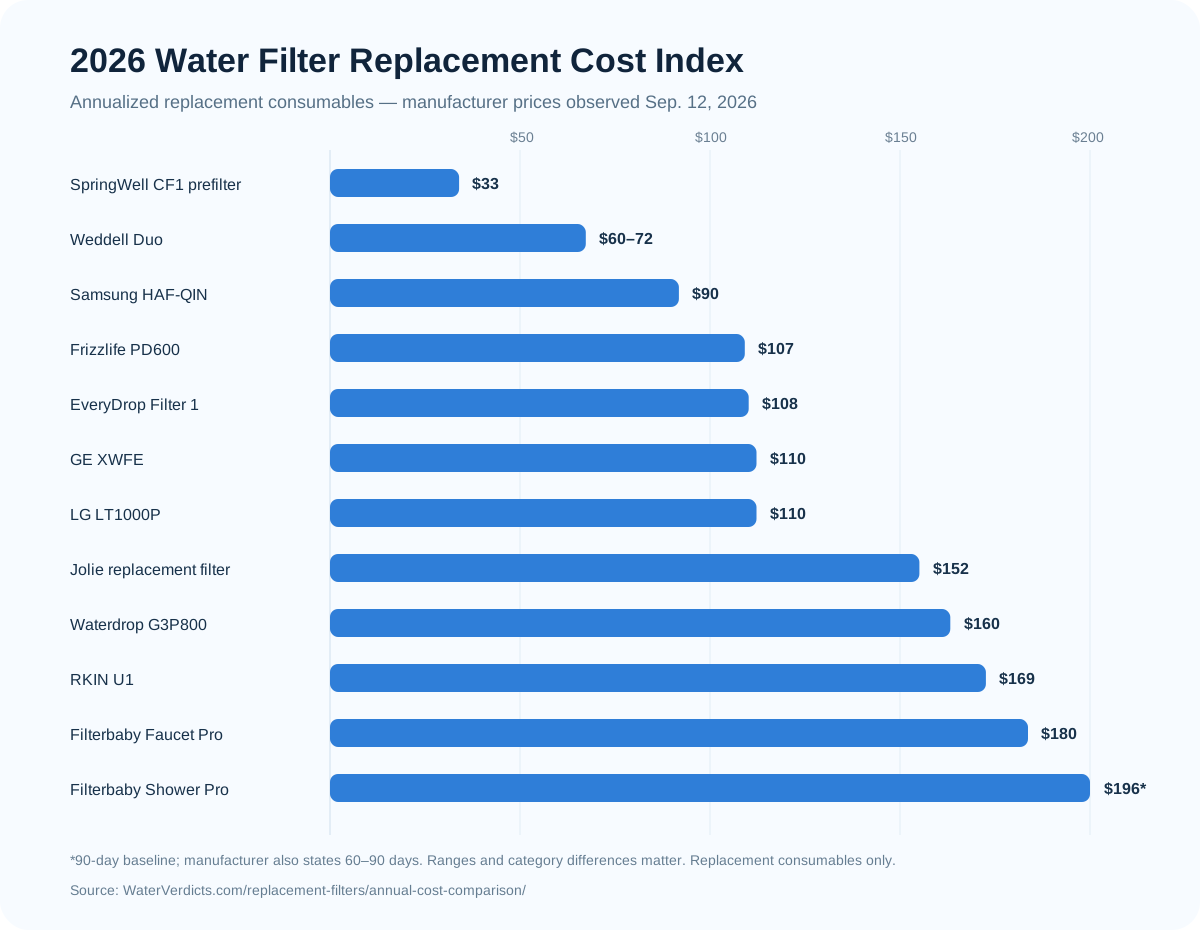
Annualized replacement-cost baseline
The chart uses the lower/standard baseline where a manufacturer publishes a range. The underlying table preserves the range and methodology.
How the index was calculated
WaterVerdicts collected prices from manufacturer or manufacturer-owned product pages rather than marketplace listings. For each product we recorded the current one-time replacement price or, when the manufacturer sells a dedicated multi-year replacement bundle, the current bundle price. We then paired that price with the manufacturer’s stated replacement interval.
For a cartridge replaced every six months, annualized cost is two times the observed cartridge price. For a 24-month membrane, annualized cost is one-half of the observed membrane price. Multi-stage systems add the annualized cost of each scheduled stage. The Frizzlife PD600 calculation, for example, annualizes the ASR211, ASR212-600G and FZ-4 stages separately before adding them together.
When the manufacturer publishes an interval range, we show an annual-cost range. Weddell recommends roughly five to six months under standard conditions, so its annualized cost is shown as a range rather than a false single-number estimate. Filterbaby states 60–90 days for its Shower Pro replacement cartridge; the table sorts on the 90-day baseline but also shows what the shorter interval does to annual cost.
The five-year column is a simple extension of scheduled replacement consumables. It does not include the initial system, taxes, shipping, electricity, wastewater, service calls, pumps, housings, tanks, electronic failures or premature filter exhaustion. It is therefore best read as a recurring consumables benchmark, not a total cost of ownership guarantee.
Frequency matters as much as cartridge price
One of the clearest patterns in the sample is that a modestly priced cartridge can become expensive when it repeats every 60 or 90 days. Conversely, an expensive RO membrane can have a moderate annual impact when it lasts two years. Buyers should therefore compare price × replacement frequency, not cartridge price alone.
OEM refrigerator filters are unusually easy to compare because GE, LG, Whirlpool/EveryDrop and Samsung all center around approximately six-month replacement schedules. In this snapshot, the annualized OEM cost clusters around roughly $90–$110, with Samsung lower because its U.S. page displayed a promotional one-time price when the data was collected.
Tankless and countertop RO systems vary more because they combine several consumables. Frizzlife PD600 annualizes to about $107 in this snapshot, Waterdrop G3P800 to about $160, and RKIN’s current two-year U1 bundle to about $169 per year. That gap can matter over a five-year ownership window even when the systems have different capabilities and feature sets.
For journalists, publishers and researchers
You may cite the findings as: “WaterVerdicts 2026 Water Filter Replacement Cost Index, prices observed September 12, 2026.” Please link to this page so readers can inspect the methodology and primary manufacturer sources.
The CSV dataset contains the price basis, replacement interval, annualized cost, source URL and notes for each entry. The SVG chart is suitable for web use and can be resized without losing quality. If you need a category-specific cut of the data, contact WaterVerdicts through the contact page.
Do not choose a filtration technology on replacement cost alone
A $40 annual prefilter does not make a whole-house carbon tank “cheaper than” reverse osmosis in any meaningful treatment sense. The technologies solve different problems. Whole-house filtration may target chlorine, chloramine, sediment or well-water issues at the point of entry. RO targets dissolved contaminants at drinking-water points. Refrigerator and shower filters operate at still different scopes.
Use this index after determining what treatment is appropriate. Then compare recurring cost among products capable of doing the same job. Our reverse-osmosis guide, whole-house guide, shower-filter guide and refrigerator-filter guide are designed for that earlier decision.
For model-level buying decisions tied directly to products in this dataset, compare SpringWell vs. RKIN for whole-house filtration and Jolie vs. Weddell for shower filtration. Both pages keep contaminant evidence separate from ownership cost.
Audit the exact replacement stack before buying
Frizzlife PD600 / PD800
Cartridge codes, intervals and replacement timing.
Read guide →Waterdrop G3P800
CF, CB and RO replacement schedule and pricing.
Read guide →RKIN U1
Prefilter, membrane, alkaline stage and hydrogen module.
Read guide →SpringWell CF1
Recurring sediment prefilter cost and timing.
Read guide →About the Replacement Cost Index
What is included in the annualized replacement cost?
Scheduled replacement filters, membranes or cartridges explicitly listed by the manufacturer for the sampled product. Device purchase price, tax, shipping, electricity, water, repairs and unscheduled early replacements are excluded.
Why are shower, refrigerator and reverse-osmosis filters in the same index?
The index is meant to show how replacement frequency and proprietary consumables change ownership cost across common residential water-treatment categories. Category-to-category cost is not a treatment-performance ranking.
Why can my real cost be higher or lower?
Promotions, subscriptions, multi-packs, water quality, household usage, sediment loading and local taxes can all change actual cost. The index records manufacturer prices observed on September 12, 2026 and annualizes their stated replacement schedules.
Can publishers use this dataset?
Yes. Publishers may cite the table or chart with attribution and a link to WaterVerdicts. The CSV and SVG are provided for easier verification and reuse.
How often will the index be updated?
WaterVerdicts plans to refresh manufacturer prices and replacement schedules periodically. Each revision will retain an observation date so historical citations remain understandable.